Back pain can make everyday activities more difficult, whether you are sitting at work, driving around the Ozarks, working around the house, or trying to stay active. When discomfort continues or symptoms begin to affect your mobility, you may start looking into different non-surgical approaches for managing your spine.
One option you may come across is spinal decompression.
Spinal decompression is a form of traction-based care designed to apply a controlled pulling force to the spine. It is often discussed in connection with back pain, leg symptoms, and certain conditions involving the discs or spinal structures. However, it is not appropriate for everyone, and the evidence surrounding traction and decompression varies depending on the condition being treated.
If you are considering spinal decompression in Branson West, it helps to understand what the treatment involves, what questions to ask, and why an individualized evaluation matters.
What Is Spinal Decompression?
Spinal decompression generally refers to a treatment approach that uses controlled forces to create traction along the spine.
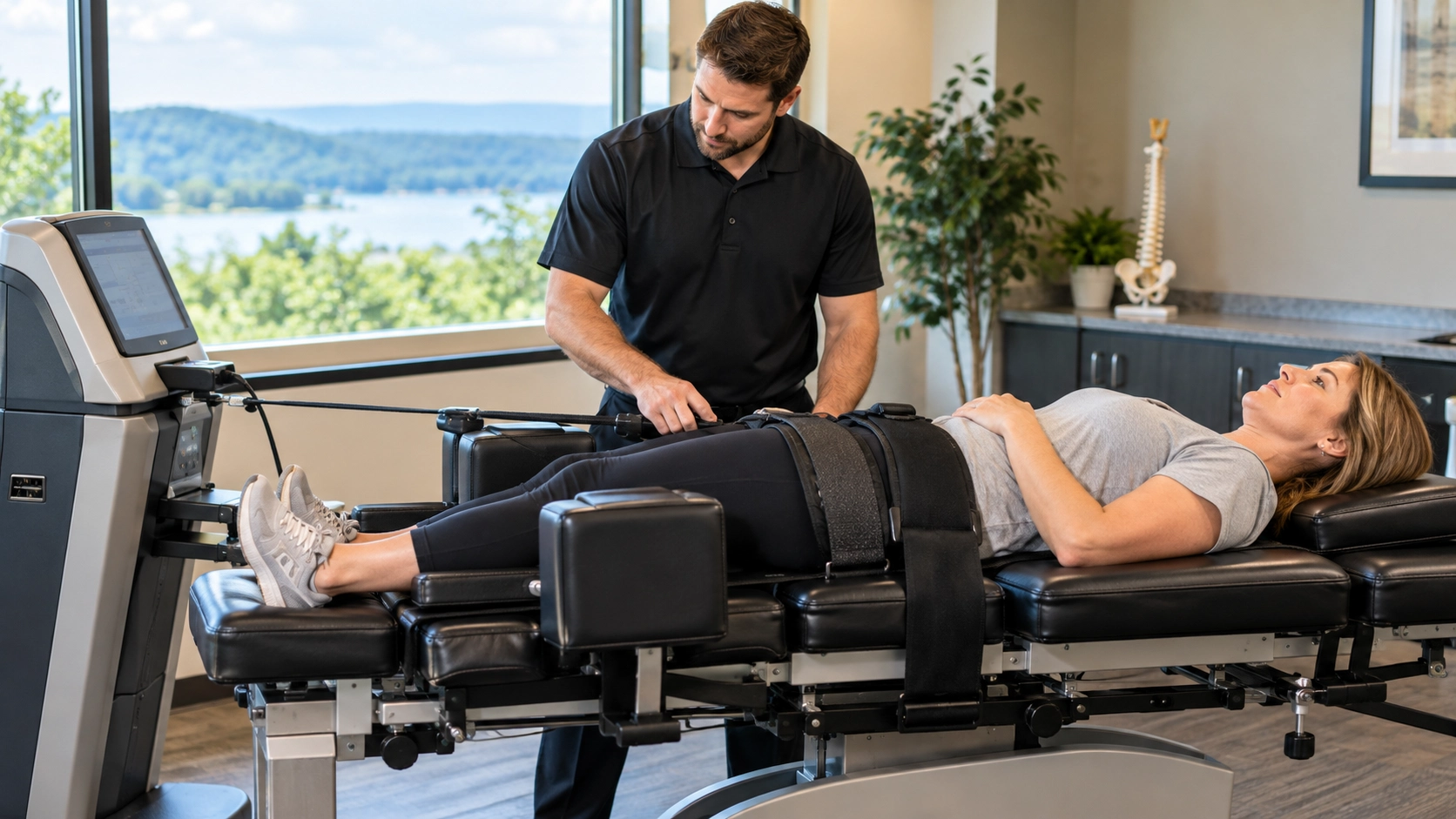
The goal is to gently change the loading and movement of the spinal structures during treatment. Depending on the equipment and technique used, a person may lie on a specialized table while the treatment applies intermittent or continuous traction.
The term “spinal decompression” is also used broadly in the healthcare and wellness industry, so it is important to understand exactly what a particular provider means by decompression and what type of treatment they offer.
At Table Rock Chiropractic in Branson West, spinal decompression is listed among the clinic’s services. The practice also offers chiropractic adjustments, rehabilitative exercises, X-rays, and other therapies.
How Does Spinal Decompression Work?
The basic concept behind traction is relatively straightforward: a controlled force is applied along the length of the spine.
Depending on the equipment and treatment approach, the force may be adjusted according to the individual’s needs and may be applied intermittently rather than continuously.
Patients are typically positioned on a treatment table, and the provider determines how the treatment should be delivered based on the person’s symptoms, history, and evaluation.
It is important not to think of spinal decompression as simply “stretching the spine.” The treatment is more specific than ordinary stretching, and the appropriate approach can vary from person to person.
A qualified provider should consider the individual’s symptoms and overall condition rather than assuming that decompression is appropriate simply because someone has back pain.
Why Do People Consider Spinal Decompression?
People often search for spinal decompression when they are dealing with persistent back discomfort or symptoms that affect their ability to move comfortably.
Depending on the individual situation, someone may be interested in decompression because they want to explore a non-surgical treatment option or because conventional approaches have not provided the improvement they were hoping for.
Table Rock Chiropractic’s website identifies back pain and sciatica among the conditions its chiropractic care may address, while also listing spinal decompression as one of its available services.
However, having a particular symptom does not automatically mean spinal decompression is the right choice.
A proper evaluation is important because back and leg symptoms can have many different causes.
Can Spinal Decompression Help Back Pain?
This is one of the most common questions people have, but there is no simple yes-or-no answer for every patient.
Research on traction-based treatments has produced mixed findings. The World Health Organization’s guideline for chronic primary low back pain recommends against using traction as routine care, citing very low-certainty evidence and uncertainty about its overall benefits and potential harms.
Other clinical guidance has similarly found that mechanical traction does not provide consistent benefit for many people with chronic low back pain. At the same time, some clinical literature has identified possible benefits for specific subgroups, which is one reason individualized assessment matters. DOI
That means spinal decompression should not be presented as a guaranteed solution for back pain.
Instead, it can be discussed as one treatment option that may or may not be appropriate depending on the person’s symptoms, diagnosis, health history, and treatment goals.
What About Sciatica or Leg Pain?
Sciatica is commonly associated with pain that travels from the lower back into the buttock and leg. Some people experiencing these symptoms search specifically for spinal decompression because they have heard that traction may reduce pressure around irritated spinal structures.
The reality is more nuanced.
Some clinical research has explored whether certain patients with signs of nerve-root involvement may respond differently to traction than people with uncomplicated low back pain. The physical therapy clinical practice guideline, for example, notes conflicting evidence overall and describes preliminary evidence for a possible subgroup with specific signs of nerve-root compression.
This is another reason why a provider should evaluate your symptoms rather than recommending the same treatment to everyone.
If you have significant weakness, progressive numbness, changes in bowel or bladder function, or other concerning neurological symptoms, seek prompt medical evaluation rather than relying on a traction-based treatment alone.
What Can You Expect During a Spinal Decompression Session?
The exact experience depends on the equipment and technique used by the provider.
In general, spinal decompression involves positioning the patient on a treatment table while controlled traction is applied.
You may be asked about your symptoms before treatment and may be monitored for how you respond during or after the session.
A good treatment experience should include clear communication. You should understand what is being done, why it is being recommended, and what you should report if your symptoms change.
If a particular position or force causes significant discomfort, communicate that to the provider.
Treatment should be based on your individual circumstances rather than on a predetermined protocol that ignores how you are responding.
Is Spinal Decompression the Same as Chiropractic Adjustment?
No. They are different treatment approaches.
A chiropractic adjustment involves a controlled movement of a joint or spinal segment. Table Rock Chiropractic offers both manual and Activator adjustments. Its website explains that Activator adjustments use a handheld instrument to deliver a quick, low-force impulse to a targeted area.
Spinal decompression, by contrast, uses traction or distraction forces rather than an adjustment impulse.
Some chiropractic practices may use decompression alongside other services, depending on the patient’s circumstances. Table Rock Chiropractic lists spinal decompression alongside adjustments, rehabilitative exercises, X-rays, and other therapies.
The important point is that these services are not interchangeable, and one should not automatically be substituted for another.
Who Should Consider Asking About Spinal Decompression?
If you are experiencing ongoing back discomfort or other spinal symptoms, you may want to ask a qualified provider whether decompression is appropriate for your particular situation.
A consultation can be especially useful if you have already tried other approaches and want to understand what options may be available.
Rather than focusing only on whether you “qualify” for decompression, a better conversation includes questions such as:
- What may be contributing to my symptoms??
- Is traction appropriate for my condition??
- What are the potential benefits and limitations??
- Are there reasons I should avoid this type of treatment??
- Are there other conservative options I should consider??
- How will my progress be evaluated??
- What should I do if my symptoms become worse??
These questions can help you make a more informed decision.
When Spinal Decompression May Not Be Appropriate
No single treatment is suitable for every person with back pain.
Your health history, symptoms, age, previous injuries, neurological findings, and other medical factors can all affect whether a particular treatment makes sense.
This is especially important because serious conditions can sometimes cause symptoms that initially resemble ordinary back pain.
If you have experienced major trauma, unexplained weight loss, fever, severe or progressive neurological symptoms, loss of bowel or bladder control, or other concerning symptoms, you should seek appropriate medical evaluation.
A treatment provider should also know about significant medical conditions, recent surgeries, fractures, or other factors that could affect treatment safety.
Why an Individual Evaluation Matters
One of the biggest mistakes people can make when researching spinal decompression is assuming that a treatment that helped someone else will necessarily help them.
Back pain is not one single condition.
Two people can both describe their symptoms as “lower back pain” while having completely different underlying problems.
One person may have muscular pain after physical activity. Another may have symptoms related to a disc or nerve. Someone else may have a condition that requires medical assessment rather than conservative chiropractic care.
That is why a personalized evaluation is important before deciding whether decompression belongs in a treatment plan.
Spinal Decompression and a Broader Approach to Care
When appropriate, spinal care does not necessarily have to revolve around one treatment.
Table Rock Chiropractic lists several services that may be used as part of its broader approach, including spinal decompression, manual and Activator adjustments, rehabilitative exercises, X-rays, roller table therapy, and other therapies.
Exercise and active rehabilitation are particularly important considerations when discussing long-term management of many types of back pain. The WHO guideline, for example, supports structured exercise programs as one option for adults with chronic primary low back pain.
The right combination depends on the individual.
Rather than asking which treatment is universally “best,” it is often more useful to ask which approach makes sense for your specific symptoms, goals, and overall health.
How Much Does Spinal Decompression Cost?
Cost is another practical question to ask before beginning treatment.
Table Rock Chiropractic’s current pricing page lists $60 for decompression and $70 for decompression combined with an adjustment. The page also notes an additional charge for insurance-covered decompression when insurance does not cover the service.
Because pricing and insurance policies can change, patients should confirm current costs and coverage directly with the clinic before treatment.
You can review the clinic’s current pricing information when planning your visit.
Choosing a Spinal Decompression Provider in Branson West
If you are searching for spinal decompression in Branson West, do more than compare treatment names.
Consider whether the provider:
- Takes time to understand your symptoms
- Reviews your health history
- Explains the treatment clearly
- Discusses alternatives when appropriate
- Avoids promising guaranteed results
- Gives you an opportunity to ask questions
- Has a broader approach to spinal care when appropriate
You should feel comfortable asking what the treatment is intended to accomplish and how your response will be evaluated.
Table Rock Chiropractic is located at 62 Elizabeth Way in Branson West, Missouri, and its website lists spinal decompression as one of its services. The clinic also serves surrounding communities including Reeds Spring, Galena, Branson, Forsyth, Blue Eye, Highlandville, Spokane, Cape Fair, Crane, Eagle Rock, and Shell Knob.
Questions to Ask Before Starting Spinal Decompression
If you are considering treatment, having a few questions prepared can make your consultation more useful.
What is causing my symptoms?
Understanding the likely source of your symptoms is more important than choosing a treatment based solely on a keyword you found online.
Is spinal decompression appropriate for my condition?
Ask why the provider believes decompression may be appropriate for you and whether there are other options worth considering.
What should I expect during treatment?
Knowing how the equipment works and what the session will feel like can help you decide whether you are comfortable proceeding.
How will we know whether it is helping?
A treatment plan should have some way of assessing whether your symptoms or function are changing.
What should I do if symptoms worsen?
Make sure you know which changes should be reported to the provider and when you should seek additional medical evaluation.
Frequently Asked Questions
What is spinal decompression?
Spinal decompression is a traction-based treatment that applies a controlled pulling force along the spine. It is offered by some chiropractic and other healthcare providers as an option for certain spinal and musculoskeletal complaints.
Is spinal decompression the same as spinal adjustment?
No. Spinal decompression uses traction or distraction forces, while an adjustment uses a controlled movement of a spinal or other joint. They are separate treatment approaches.
Does spinal decompression work for everyone?
No. Evidence for traction-based treatments is mixed, and clinical guidelines do not recommend traction as routine care for chronic primary low back pain. Whether it is appropriate depends on the individual and the nature of their symptoms.
Can spinal decompression help sciatica?
Some research has explored traction for people with leg symptoms or signs of nerve-root involvement, but results are not consistent. A provider should evaluate the cause and characteristics of your symptoms before recommending treatment. DOI
How much does spinal decompression cost at Table Rock Chiropractic?
The clinic’s current pricing page lists decompression at $60 and decompression with an adjustment at $70. Insurance coverage may vary, so it is best to confirm current pricing and coverage directly with the clinic.
Where can I get spinal decompression near Branson West?
Table Rock Chiropractic lists spinal decompression among its services and is located at 62 Elizabeth Way in Branson West, Missouri. The clinic also lists several surrounding Ozarks communities in its service area.
Considering Spinal Decompression in Branson West?
If you are dealing with back or other spinal symptoms and want to learn whether spinal decompression is appropriate for your situation, a conversation with a qualified provider can help you understand your options.
Table Rock Chiropractic offers spinal decompression along with chiropractic adjustments, rehabilitative exercises, X-rays, and other therapies. Rather than assuming one treatment is right for everyone, discuss your symptoms, health history, and goals with the clinic so an appropriate approach can be considered.